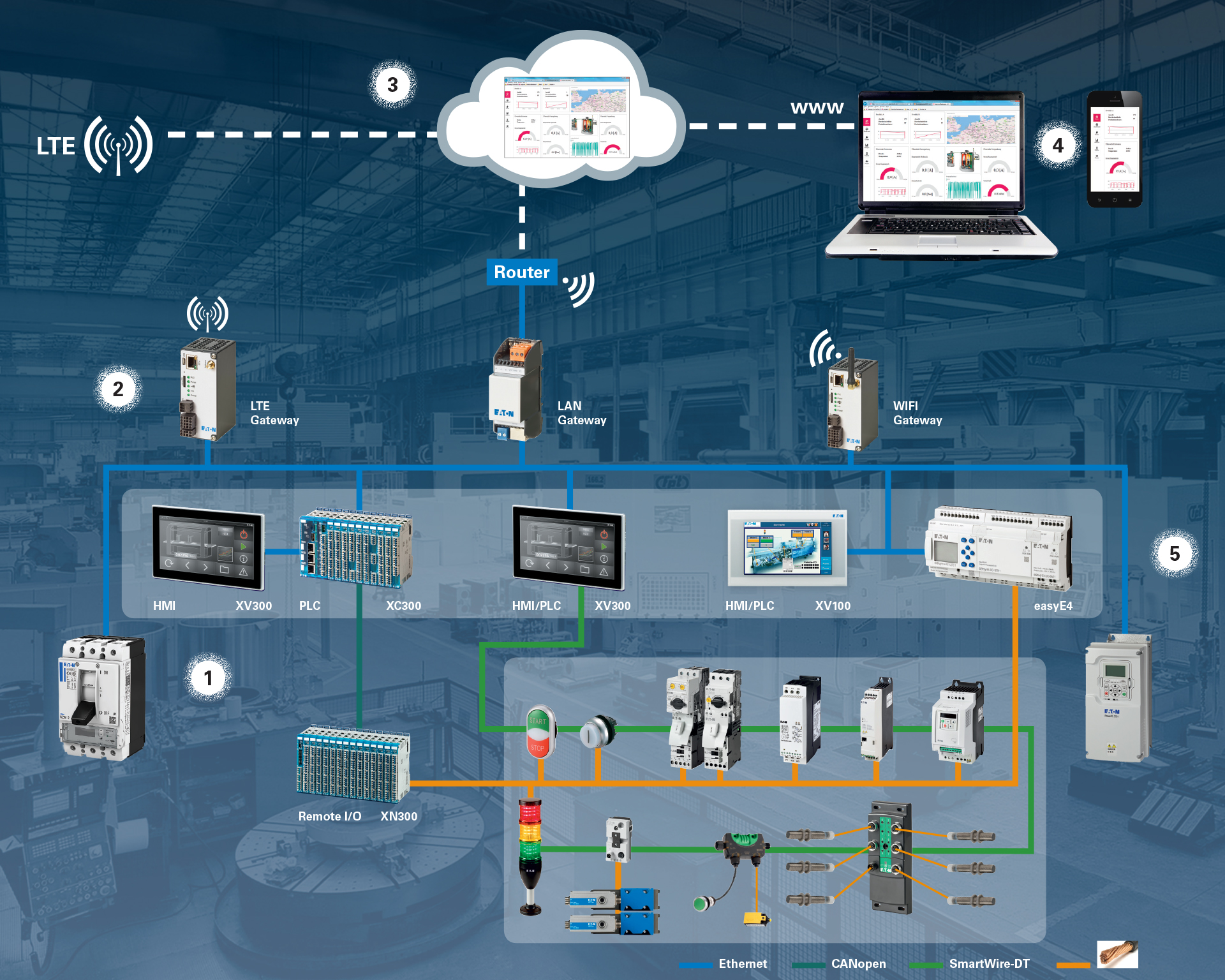
Even in its default configuration, the NubisNet cloud offers many useful functions. Through a dashboard function, the data can be displayed in many variants (as numerical values or via graphical elements). As the dashboards are "responsive", they are automatically optimized for access from a PC as well as from a smartphone. In addition, "roles" can be defined so that specific sets of data can be made available to third parties or other companies. E-mail alarm management is also easily configurable so that critical machine conditions or maintenance operations can be communicated directly to the people in charge to maintain machine uptime.
The NubisNet features mentioned in step 4 are available to users both in the cloud and on-premise server systems. Preventive maintenance and maintenance optimization can be successfully applied after a short time. Beyond that, the available data offers much more room for improvement. Thus, the gained insight into the process flows can be used for their optimization. Energy data contributes to greater transparency and can also be used for targeted measures to reduce or optimize energy consumption. If individual logical or mathematical functions are required, the Eaton service is available to adapt functions or even to implement new individual functions for the customer.
Eaton's end-to-end approach begins with process and environmental data inside and outside the control cabinet. Smart devices like variable frequency drives or the electronic motor starter PKE deliver their data via a fieldbus connection. For electronic mechanical motor starters, sensors or other field devices, the intelligent communication system SmartWire-DT is ideal. All available data is transmitted to the central controller, the HMI / PLC or directly to the gateway.
The process data from the smart devices and from the central controllers can be transmitted to the gateways via fieldbus (Modbus RTU) or via Ethernet. A user-friendly device manager makes the connection easy to configure. The gateway transmits the data with end-to-end encryption according to TLS 1.3 standard and mandatory authentication to the central NubisNet data broker or the local on-premise server. Transmission is also possible via MQTT or OPC/UA.
The collected data can be stored and processed on different servers / IT infrastructures. One possibility is an on-premise server which is ideal, when the data should not leave the end user's IT network. For data that is designated to be shared with third parties, a cloud is typically the better solution. For the data transfer to the NubisNet data broker, two cost-optimized tariffs (basic, advanced) are available for different amounts of data. The data broker transmits the data to the system requested by the customer. This can be either the ISO / IEC 27001 certified high-security NubisNet cloud or any other preferred system (Azure, AWS, T-Systems, etc.). The transfer to 3rd party systems is realized via an API.